If you run Meta ads that send people into Telegram channels, you already know the problem: Meta optimises for clicks and landing-page views, but your real conversion — the Telegram join — happens off-platform where the pixel can’t see it. Generic PPC reporting tools like Supermetrics and AgencyAnalytics won’t help here. They report CTR and CPM; they have no idea who joined your channel.
This guide compares the tools that actually close that loop — attributing Telegram joins back to the exact ad, campaign, and creative that drove them, usually via the Facebook Click ID (fbclid) and Meta’s Conversions API (CAPI).
What to look for in a Telegram tracking tool
- Per-ad attribution — joins mapped to the specific ad/creative, not just a campaign total.
- Meta CAPI postback — joins sent back to Meta so the algorithm can optimise for community growth.
- Finance-vertical fit — FTD (first-time deposit) and revenue tracking for forex, crypto, and iGaming.
- Multi-client structure — agencies need a Client → Brand → Account hierarchy, not a flat list.
- Predictable pricing — flat fees, with no wallet to top up, beat percentage-of-spend or per-event billing as you scale.
| Ott | TGTracker | ClickGram | Optivyro | AdTarget | TracerGram | |
|---|---|---|---|---|---|---|
| Per-ad Telegram attribution | ✓ | ✓ | ✗ | ✗ | ✗ | ✓ |
| Meta CAPI postback | ✓ | ✗ | ✓ | ✓ | ✓ | ✗ |
| FTD / deposit tracking | ✓ | ✗ | ✗ | ✗ | ✗ | ✗ |
| Client → Brand hierarchy | ✓ | ✗ | ✗ | ✗ | ✗ | ✗ |
| Full Meta campaign analytics | ✓ | ✗ | ✗ | ✗ | ✗ | ✗ |
| Budget monitoring | ✓ | ✗ | ✗ | ✗ | ✗ | ✗ |
| Flat pricing (no % of spend) | ✓ | ✗ | ✓ | Custom | ✗ | ✓ |
| No prepaid wallet to babysit | ✓ | ✗ | ✓ | Custom | ✗ | ✓ |
A €2 cost-per-join looks great until you put cost-per-FTD next to it. One channel can flood you with cheap joins that never deposit, while a “pricier” channel brings in members who fund accounts on day one. If your tool reports joins but not the deposit behind them — as every standalone tracker in this list does — you’re optimising toward the wrong number and quietly starving your best-earning campaigns.
The tools, ranked
Ott — best overall for finance agencies
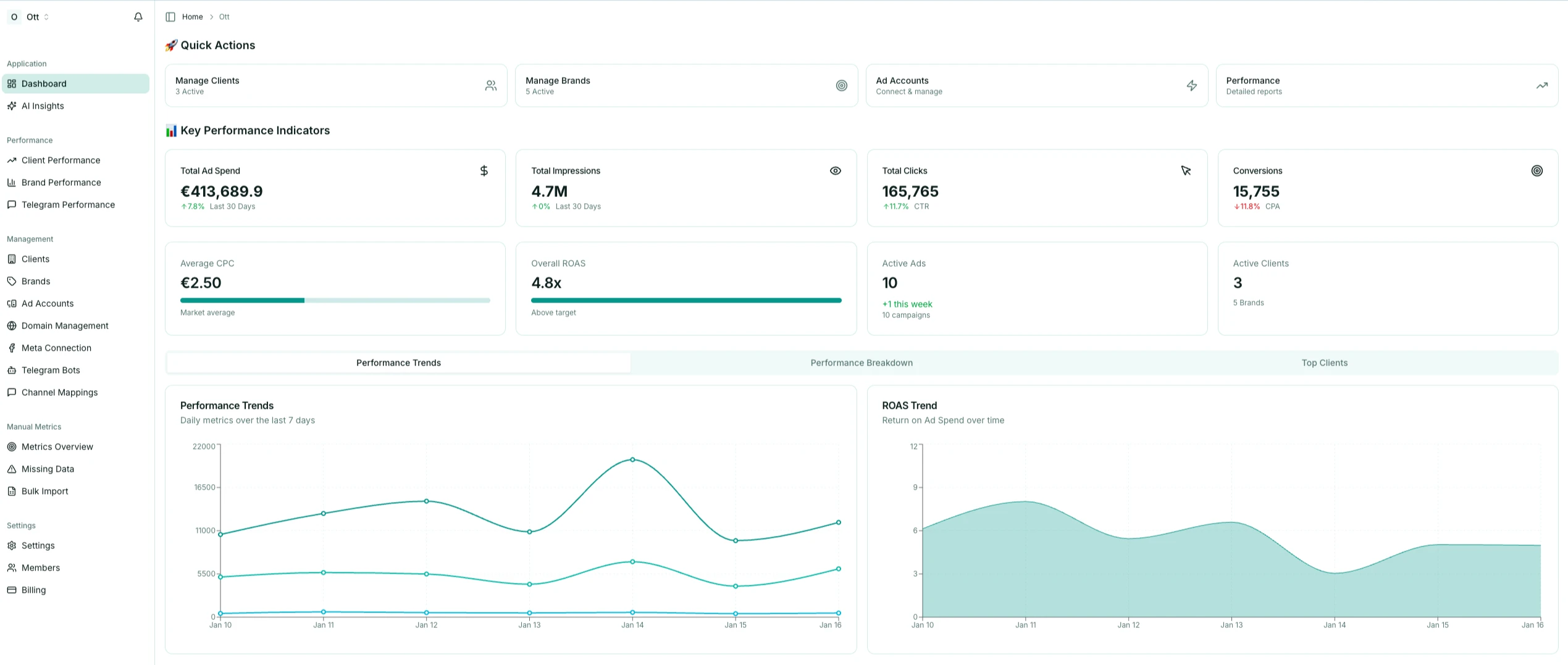
Top pickOtt is the only tool here that is a full agency platform, not just a tracker. It attributes Telegram joins per ad via the Facebook Click ID, sends them back to Meta through CAPI, and sits on top of complete Meta campaign analytics, a Client → Brand → Account hierarchy, budget monitoring, and FTD logging — the metrics finance clients actually pay you to deliver.
Every other tool below closes only one piece of this loop, so you end up stitching a tracker onto a reporting tool onto a spreadsheet. Ott collapses all of it: spend, cost per joinee, and cost per deposit live in one dashboard, per client, at a price that doesn’t move when your ad spend does.
TGTracker — a join postback that taxes your spend
TGTracker attributes Telegram joins to the ad that drove them, and does that one job simply. But it stops dead there — no Meta CAPI postback, no FTD tracking, no client hierarchy, no campaign analytics — and it bills a percentage of your ad spend, so the better a client scales, the more you pay to watch a single number. Worse, it runs on a prepaid in-app wallet: if the balance runs dry — or you just forget to top it up — tracking stops and the joins stop reaching your channel, so you lose the data and the members at the same time. Ott does the same attribution, feeds it back to Meta, ties each join to its deposit, and charges a flat fee with nothing to top up.

ClickGram — affiliate S2S, not agency reporting
ClickGram is built for affiliate S2S workflows and handles postbacks competently for that crowd. For a finance agency it’s the wrong shape: ~$750/mo for a single-purpose tracker with no Meta campaign analytics, no Client → Brand hierarchy, and no FTD ledger — so you still can’t tell a client which creative funded the most deposits. Ott gives you that full chain, structured per client, for less than ClickGram charges to track links.

Optivyro — CAPI-first, but blind after the postback
Optivyro does the hard part of Meta Conversions API integration well for high-risk verticals — CAPI postback is a genuine strength. The problem is everything around it: no per-ad Telegram attribution, no FTD tracking, no budget ledger, no client reporting, and “contact sales” pricing you can’t plan a margin against. Ott sends the same CAPI signal, then actually shows you the ad, the join, the deposit, and the client P&L on top of it.
AdTarget — multi-channel CAPI with runaway billing
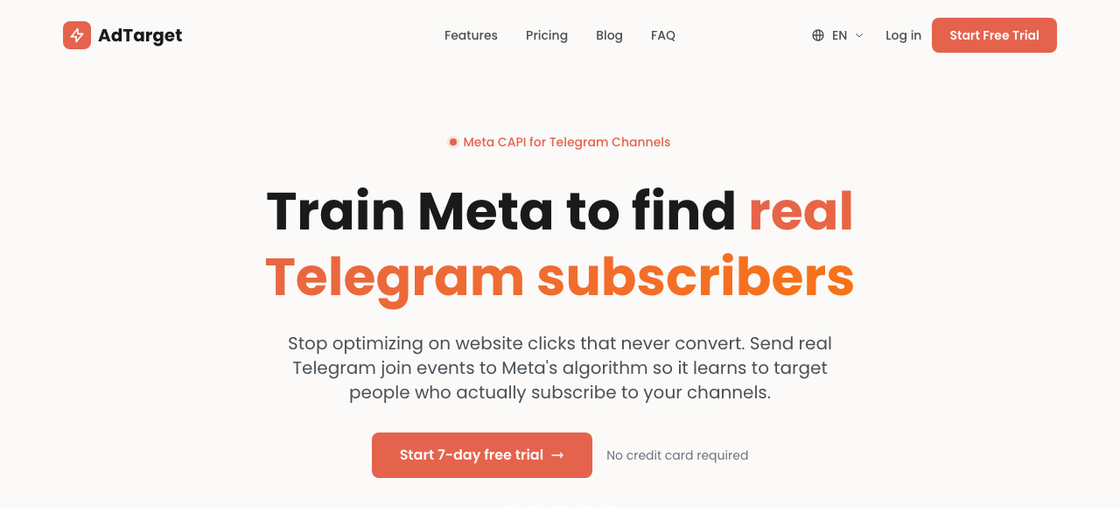
AdTarget covers CAPI across Meta, TikTok, and Snap, which is useful if you truly buy on all three. But pay-per-event billing means every conversion you track makes your invoice bigger — the exact opposite of what you want as a client scales — and it remains a tracker, with no FTD reporting, no agency hierarchy, and no budget monitoring. Ott tracks unlimited joins and deposits at a flat rate and wraps them in the campaign and client reporting AdTarget never had.
TracerGram — a flat fee is its only real advantage
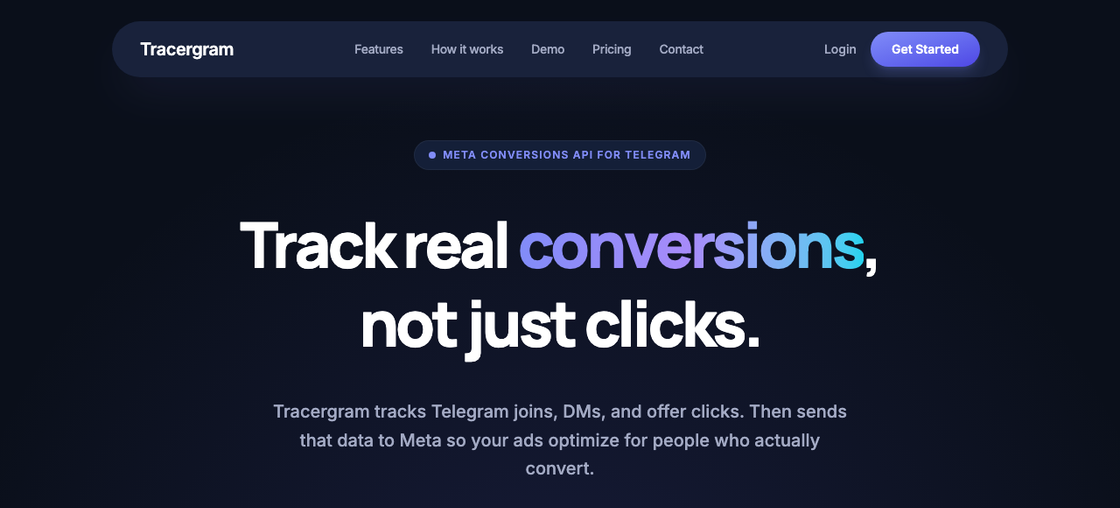
TracerGram’s one virtue is that its price is flat — and that’s where the case for it ends. It tracks Telegram joins for a single channel and nothing else: no Meta campaign analytics, no Client → Brand hierarchy, no budget control, no FTD reporting, no CAPI postback. A solo buyer with one channel might tolerate it, but an agency running several finance clients outgrows it in week one and is left reconciling yet another standalone tool by hand. Ott is also flat-priced — and delivers the entire agency stack TracerGram leaves out.
What about Supermetrics, AgencyAnalytics, and the rest?
General PPC reporting tools simply don’t track Telegram. They connect to Meta’s API and report standard ad metrics — useful, but blind to what happens after the click. If your conversion event lives inside a Telegram channel, a reporting connector can’t answer the one question your client is paying you to answer: which ad drove the joins that deposited? Ott starts where those tools stop — it reads Meta’s API for the full campaign picture and closes the Telegram loop underneath it.
The verdict
Every alternative here is a single feature dressed up as a product: a join postback (TGTracker, TracerGram), an affiliate S2S layer (ClickGram), or a CAPI pipe (Optivyro, AdTarget). Any one of them can cover a solo buyer with one channel and a fixed budget. None of them survives contact with a real agency book — the moment you manage several finance clients, the standalone-tracker tax in money, reconciliation, and missing context compounds every month.
Ott is the only option that tracks Telegram joins per ad, posts them back to Meta, and ties each one to its deposit and gives you the full Meta campaign analytics, Client → Brand → Account hierarchy, budget monitoring, and FTD reporting an agency actually runs on — at a flat price that never grows with your ad spend. That’s not a tracker with extras; it’s the platform the trackers are a feature of.
Any tool priced on % of spend (TGTracker) or per event (AdTarget) gets more expensive precisely when a campaign works. Scale a winning client from €20k to €80k/month and your “cheap” tracker quietly quadruples — you’re taxed for doing your job well. Flat pricing turns tracking into a fixed cost you can build into a client’s retainer, so every extra euro of managed spend lands in your margin, not your vendor’s.
Start a free trial or book a demo to see Telegram attribution in your own funnel.