A Telegram join is a soft signal. For a forex broker, crypto exchange, or signals provider running Meta ads, the only join that pays rent is the one that turns into a first-time deposit. If you are buying media against a channel that gains 4,000 members a month and converts almost none of them, your real cost-per-FTD is buried under a vanity number that looks great in a screenshot and tells you nothing.
This guide is about reading Telegram engagement the way a media buyer in a regulated vertical should: as a leading indicator of deposit intent, tied back to the specific Meta ad that drove the join, not as a community-management exercise. If you sell signals, run an iGaming funnel, or push forex offers through a channel, the question is never “how engaged is my channel” in the abstract. It is “which ads bring members who actually deposit, and how fast can I tell the difference.”
Why Member Count Lies to Finance Buyers
Join count is the easiest number to inflate and the worst one to optimise against. In high-risk verticals the gap between joins and revenue is enormous because cheap traffic is everywhere and most of it never funds an account.
Three things make raw joins misleading for finance funnels specifically:
- Bot and incentivised joins. Forex and crypto offers attract join farms and giveaway hunters. They spike your member count and crater every downstream metric.
- Tier-1 vs tier-3 geo mixing. A €0.40 join from a low-intent geo and a €3.50 join from a depositing market look identical in a member count. They are not the same asset.
- No link back to spend. Telegram’s native member graph cannot tell you which Meta ad, ad set, or campaign produced a given join. Without that link, engagement is just trivia.
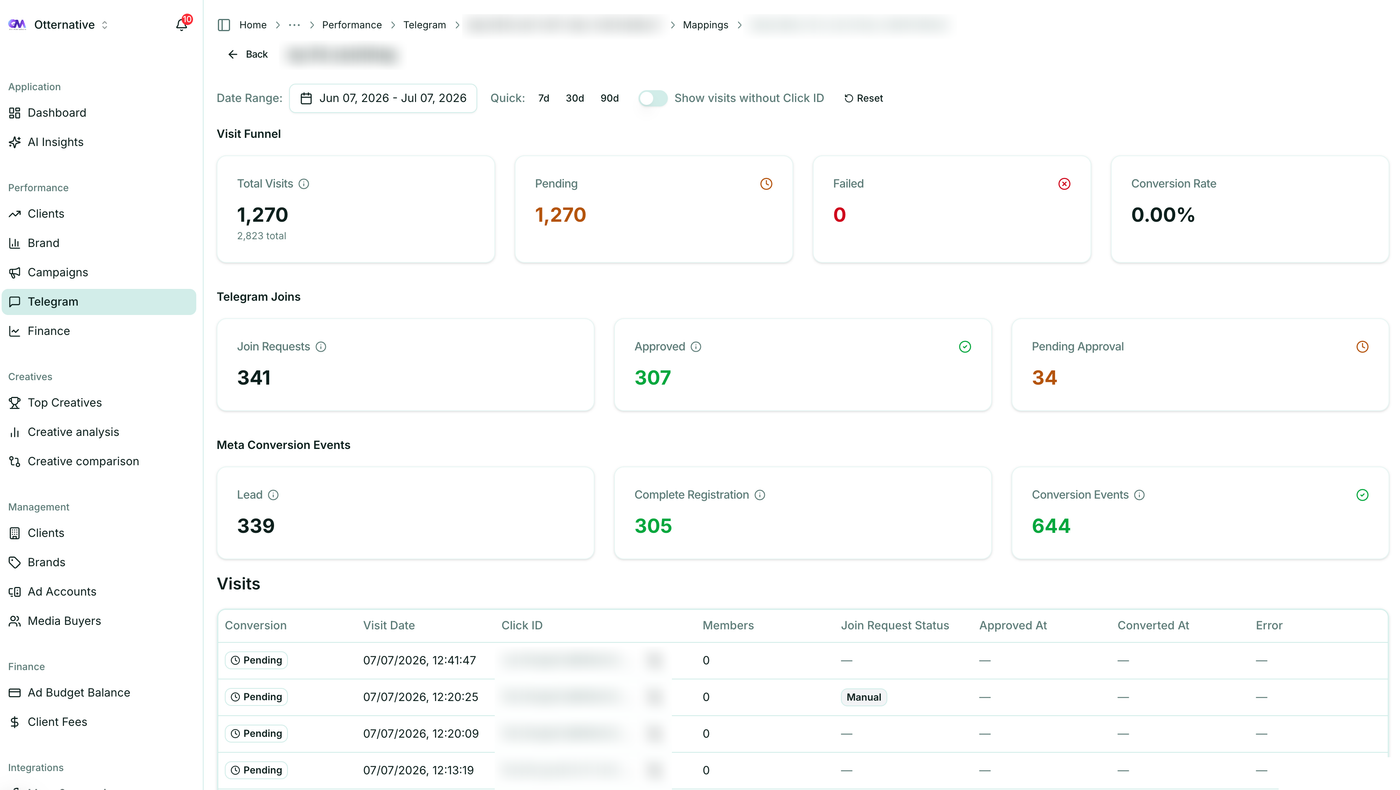
The fix is attribution at the join level. Ott’s Telegram conversion tracking attributes each join to the Meta ad that drove it via the Facebook Click ID (fbclid), then sends the event back to Meta through the Conversions API. Once a join is tied to an ad, every engagement metric below can be read per creative, per ad set, and per geo — which is where the real decisions live.
The Engagement Metrics That Actually Predict Deposits
Forget channel-wide averages. Score engagement against the next funnel step: the FTD. These are the signals that correlate with deposit intent in finance verticals.
Join-to-FTD Rate (the metric that matters)
This is the one number to build your media buying around. Of the members an ad drove into the channel, what percentage logged a first-time deposit?
- How to read it: segment by Meta ad, not by channel. A campaign-level join-to-FTD of 6% can hide one creative converting at 14% and three converting at 1%.
- Why it beats view rate: message views measure curiosity. Deposits measure money. In regulated niches the correlation between the two is weaker than people assume.
- What to do with it: kill or rework ads below your break-even join-to-FTD; scale the ones above it. Track this inside campaign triage so the laggards surface before they drain budget.
Cost-per-Telegram-Join, Read Alongside Cost-per-FTD
Cost-per-join on its own is a trap. A cheap join that never deposits is more expensive than an expensive one that does.
- Always pair the two: an ad at €1.20 per join and €45 per FTD beats an ad at €0.50 per join and €120 per FTD.
- Watch the ratio over time. A widening gap between falling cost-per-join and rising cost-per-FTD is the earliest sign a creative is fatiguing into low-quality traffic.
- Because Ott charges a flat monthly fee with no per-Telegram-join fee, you can track every join without your tooling cost scaling against the exact metric you are trying to grow. Percentage-of-ad-spend trackers punish you for volume.
Time-to-First-Action
How long after joining does a member do something that signals intent — clicking the broker link, opening the bot, replying to the welcome flow?
- Members who act within the first hour deposit at far higher rates than those who lurk for a week.
- Use it to grade creatives: an ad that brings fast-acting members is worth more per join than its raw conversion rate alone suggests.
Welcome-Flow Click-Through
The link in your pinned message or onboarding sequence — the one pointing to the deposit page or registration form — is the bridge between join and FTD. Its click-through rate is a direct funnel-efficiency lever.
- Benchmark against your funnel, not generic channels. A signals channel pushing a single broker offer should expect a far higher CTR than a content channel.
- A weak welcome CTR with strong joins means your funnel, not your media, is leaking. Fix the onboarding before spending more on traffic.
Geo and Cohort Quality
Group joins into cohorts by ad and geo, then watch them mature.
- A cohort that joins fast but stops engaging within 72 hours is low-intent traffic dressed up as growth.
- Compare 7-day and 30-day FTD rates per cohort to separate ads that bring depositors from ads that bring tourists.
How This Maps to Your Funnel Levels
Engagement is only useful when it is tied to a funnel stage you can act on. For a finance channel the funnel is roughly:
- Ad click → measured in Meta
- Telegram join → attributed via fbclid
- Welcome-flow action → bot click, link click, reply
- Registration → broker or exchange signup
- FTD → the conversion that funds the business
Ott’s CAO funnel analysis reports cost-per-acquisition efficiency at each level, so you can see exactly where members fall out. If joins are strong but registration is weak, the problem is your onboarding. If registration is strong but FTD is weak, the problem is your offer or your broker handoff. Reading engagement without this map is how agencies end up scaling traffic into a leaky funnel.
What to Stop Measuring
Some metrics feel like progress and produce none. In finance verticals, deprioritise:
- Total member count as a headline KPI. Report it once; optimise against join-to-FTD instead.
- Channel-wide reaction rate. Reactions are noise in a deposit funnel unless they correlate with action, and they rarely do.
- Generic “engagement rate” benchmarks lifted from content or creator channels. Your benchmark is your own break-even cost-per-FTD, full stop.
This is the core difference between a community-growth mindset and a media-buying one. You are not building an audience for its own sake. You are buying depositors and using Telegram as the conversion surface.
Closing the Loop Back to Meta
The highest-leverage move is feeding deposit-grade engagement back into Meta’s optimisation. When a join converts to an FTD and that event is sent to Meta via CAPI against the original fbclid, Meta’s algorithm learns which audiences produce depositors, not just joiners. Over a few weeks this shifts delivery toward the cohorts that fund accounts — the compounding advantage that pure join-count tracking can never deliver.
For regulated verticals this also matters for resilience. Agencies running multiple Business Managers to survive bans need conversion signals that travel with the ad, not locked inside a single tool. Attribution at the join level, fed back through CAPI, is what makes that portable.
Ott sends every attributed join — and its downstream FTD — back to Meta via CAPI against the original fbclid, so the algorithm learns which audiences fund accounts. The signal lives with the ad, not the Business Manager, which is what keeps it working through bans and rebuilds.
Measure What Deposits
Telegram engagement only means something when it predicts a deposit. Track join-to-FTD per ad, pair every cost-per-join with its cost-per-FTD, watch time-to-first-action and welcome-flow CTR, and grade cohorts by how they mature — not by how many members you added this week. Do that and your Telegram channel stops being a vanity dashboard and starts being a forecastable acquisition channel.
Want to see which Meta ads actually drive depositing Telegram members? Start a free trial — no credit card required — or book a demo and we’ll map your join-to-FTD funnel against your current spend.